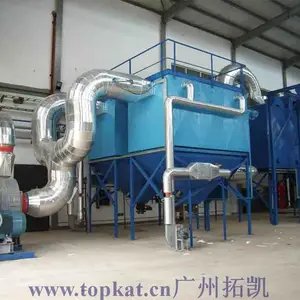
Topkat high-temperature filter elements are mounted on the tube sheet at the top of the filter housing. High-temperature dust-laden gas enters the dirty-air plenum and passes through the filter elements from the outside in, drawn by the induced draft fan. Particulates are captured on the outer surface of the elements, while clean gas passes through the filter media into the clean-air side. The dust cake that forms on the element surface also contributes to filtration of the hot exhaust gas.
As the filter cake thickens, the pressure differential across the filter rises. When it reaches the design value, a differential-pressure sensor or electronic timer triggers the pilot valve, which opens the diaphragm valve and releases a pulse of compressed gas into the filter inlet. The reverse airflow and its pressure dislodge the filter cake from the outer surface of the filter elements. The dislodged filter cake falls into the dust hopper below.
Key features of Topkat high-temperature flue gas filters:
- Heat-resistant and non-combustible up to 1,000°C
- Resistant to chemical corrosion, including strong acids and alkalis
- Long service life — up to five years under normal operating conditions
- High filtration efficiency — outlet dust concentration below 5 mg/Nm³
- High filtration accuracy — captures particles smaller than 1 micron
- High strength and wear resistance — no perforation or breakage
- Extremely low filter resistance — below 20 Pa
- High filtration velocity — operates at 2 m/min without difficulty
- Compact footprint — about half the space of a baghouse
- No carburizing
- Can be cleaned by compressed-gas back-pulse or with water.
- Operates reliably in high-pressure environments without damage