
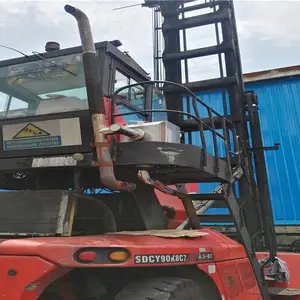
Topkat Forklift Exhaust Gas Purifier / Forklift Black Smoke Purifier Manufacturer

Product Introduction

The TPS forklift black smoke purifier removes black smoke with over 90% filtration efficiency. It is fully emission-compliant, can be washed and regenerated in about one minute, and offers a long service life, impact resistance, cost-effectiveness and easy installation. Ideal for black smoke control on non-road machinery.

Specifications

Product ID4620799448
Ref. Price21800.00 ~ 23500.00 yuan/set
Supply9999999 units
Delivery3 days
Keywordsblack smoke purifier manufacturer, forklift exhaust gas purifier, black smoke purifier
Product characteristicsMetal, washedProcessing and customizationYes
BrandTopkatModelTP-3,TP-5,TP-10
Gas processing volume100000m³/hPurification rate99.9%
SpecificationsComplete

Detailed Overview

1、Working principle

Diesel exhaust enters the TPS filtration system through its inlet. The gas, laden with carbon particulates, passes through the filter element wall from the outside in, where the particles are captured. Clean gas is then discharged into the atmosphere through the outlet.

As the engine runs, carbon particles build up on the outer surface of the filter element, gradually raising system back pressure. When the back pressure reaches the set level, stop the engine, release the clamp, pull out the filter element, rinse it under a water tap, reinstall it in the housing and retighten the clamp. The purifier is then ready for use again, and this cycle can be repeated indefinitely.

2、Filtration efficiency

Topkat's TPS exhaust gas purifier achieves filtration efficiency of over 90% and meets national emission standards.

The initial back pressure of the TPS diesel exhaust purifier is as low as 1 kPa, so the unit has virtually no effect on engine performance. Its specially designed particulate trap offers a high soot-holding capacity and long service intervals without maintenance.

3、Advantages of TPS diesel exhaust purifier

  1. Particulate filtration efficiency exceeds 90%, fully meeting emission standards.
  2. Simple maintenance — the filter element can be rinsed and regenerated in about one minute;
  3. Easy installation — clamp-on design for fast fitting and removal in under 30 seconds;
  4. Zero secondary pollution;
  5. Low overall cost, easy retrofit and simple maintenance. Compared with conventional ceramic DPF purifiers for diesel vehicles, the main advantages of the TPS metal exhaust purifier are:
  6. The TPS purifier has a filtration efficiency of greater than 90% and can fully meet environmental protection requirements; while traditional DPF often fails to meet environmental protection requirements when encountering high concentrations of black smoke.
  7. The TPS purifier can be washed and regenerated in one minute and reused repeatedly without damage.

A conventional DPF clogged with soot must be removed and sent back to the factory. Burning off the carbon deposits in a heating furnace takes several hours, and both heating and cooling must be done slowly or the ceramic substrate may crack. Afterward, compressed-air backflushing is required to remove the residual ash. Even so, a ceramic DPF is typically worn out after five to six cleaning cycles.

  1. The TPS purifier is all-metal and highly resistant to damage during transport, installation and operation, whereas the ceramic DPF is fragile by nature.
  2. The TPS core is made of a high-temperature-resistant, corrosion-proof metal with an extremely long service life — under normal use it lasts roughly as long as the vehicle itself. In contrast, the thin walls of a ceramic DPF can be eroded by airflow or burned through by high temperature if carbon deposits are not removed in time.
  3. The TPS purifier can be sized to fit the installation space and suits diesel engines of all power ratings. Ceramic DPF units come in fixed core sizes, so capacity can only be increased by adding more elements — often impractical where installation space is tight.
  4. Compact and lightweight — the TPS purifier weighs less than half of a comparable ceramic DPF unit.
  5. Low overall cost and easy to retrofit. Ceramic DPF units are difficult to encapsulate and modify, and cost more.

(Terms:

DPF (Diesel Particulate Filter): a particulate trap available in two types — ceramic and metal.

Regeneration: the process of cleaning the DPF when it becomes blocked by particulate matter (PM) and carbon deposits, restoring its filtration capacity. )